Showing posts with label Unit X:College One. Show all posts

Saturday, 11 May 2013

College One: Timetabled run through of our workshop...


Above is the timetable we used for how the day would run. 

Before the children would come at 9:30am, we would have to sew the 2 pieces of large canvas together and iron it out, set up the chairs for the presentation and remove all the tables out of the way and set up the presentation. We also would layout all of the recyclable materials that they would be choosing from.


As the children come in, we would ask them to put there overalls on and give them goggles to start with. As for the Introduction, we did a presentation that ran through what we was going to do for the day. It included Contextual Research that put how we got to this workshop idea into context, why we was recycling materials to make paint, the pros and cons of recycling and why they was doing this workshop- to experiment with mark-making and exploring other areas of art and what is considered a piece of art. 


Whilst the children went off for their first break, we would take this opportunity to set up the blending and making paint stations. We had to newspaper all the tables, put no slip matts down, lay out the cutting equipment such as: scissors, knifes, folks, rolling pins and hammers, set up the blenders, oil and cups. We also removed all of the chairs.


After their first 20 minute break, the children would come back and we would split them up into 2 groups. Each group would then be designated into either a blending or making paints stations, we would split ourselves up within the groups at each station, it would work out at the minimum of 2 'teachers' per station. The groups would then swap over so everyone had the opportunity to try both, this gave us the option to try both as well. Once both groups had tried both stations and settled into their second one, all of us 'teachers' would then spread out around the room and work with the other students. Once this section was done with, we would have a small cleaning session which would lead to dinner.


Through dinner we would put all of the equipment away and put away the tables left out for the stations away to give room for the children to make the hanging device and to layout the canvas.
After dinner, it would be time to fill the balloons and make the hanging device. The children would be split up back into there groups and sent to either station and then they would swap over again. At this point, I would remain at filling the balloons until the hanging device was made and once it was up, I would then start to hang the balloons using string and all the children would help, if the device was too high, the 'teachers' would attach the string to the device whilst the children attached the balloons to the string. 


We then clean up everywhere, this can take a lot of time and keeping the children's attention to help can be even harder. Once it is all cleaned up, some of us would take the children into another room and get their feedback through little post-it notes. This helps us find out what we could improve and what worked. Whilst we do this, Rory, Denise and Hayley would set up all the camera equipment. We would also lay and flatten the canvas. Once it is all set up, the children would come back in and take some pictures, maybe even a group photo? The fun would then begin.

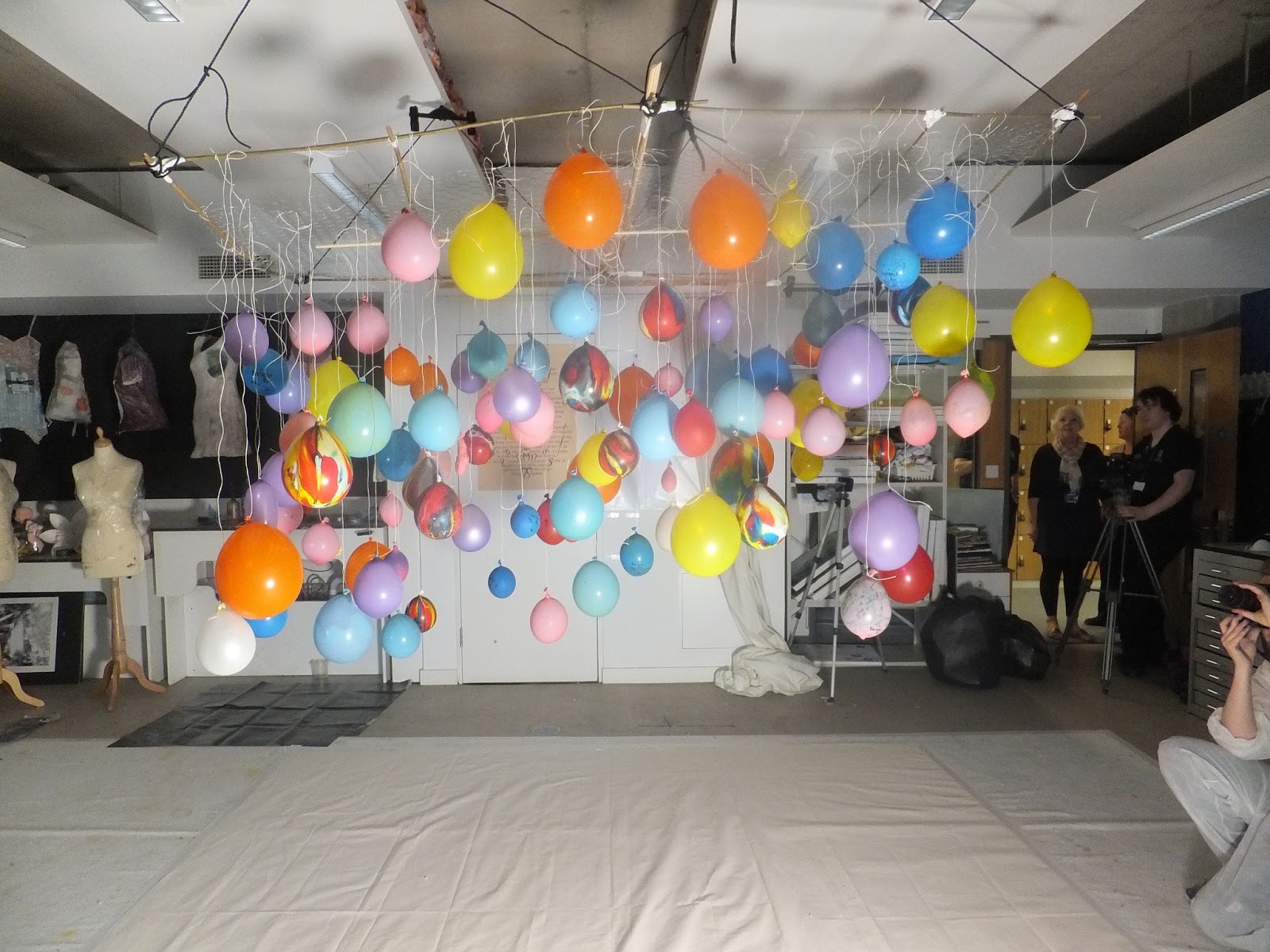

As we wanted to film and take pictures of the children popping the balloons, they were put back into their groups and took it in turn. All of the children would be wearing overalls, mouth masks as well as goggles for protection.     


Our second run of the workshop...

It was our second run of our workshop and the first thing that stood out to me was the atmosphere and how relaxed it felt. We had originally planned for a rotation for who would present the presentation but for today, we all stood at the front and each said something, no matter how small it was, everyone engaged well together and I think this time around the children engaged more as well, they asked questions and seemed excited from the offset. Some of the children had even heard about the workshop from the children from the last one we did, they said they enjoyed it and someone even put a picture of it on Instagram, which I found really sweet and encouraging that what we did was successful.


For this workshop, we had 2 less helpers but it did not seem to hinder the day, we actually ended up finishing earlier than the first workshop, I think this is because we was aware and more prepared of how it would run, what could go wrong and how we improved it from last weeks workshop. We did change a few things from last workshop. We did not use white spirit as this is what we though caused the balloon to pop earlier than expected, we originally used it so that the wet paint balloons would dry because food was used and for it to help to stick dry balloons that had been popped, I am worried about whether the final 2nd canvas will dry but we did encourage more wet balloons than dry ones, as well as sieving out big clumpy parts. For this workshop we had the children filling the balloons and pumping them up, we did it with them but I think they became more independent at this point, the only thing most of them could not do was tying the balloons so this is where we stepped in. The hanging device this time around had to be sturdier than before because we noticed it dipped a lot once all the balloons were up, we also had the children attaching the balloons to the device but near to the end, the children started becoming silly by wanting to get in the middle of them so we had to ask them to get down and add the rest of the balloons ourselves.


I enjoyed the workshop but I feel like there is not enough roles to go around. At certain points in the workshop I found myself just stood there or cleaning up just to give myself something to do.


Working with different people from different fields in Art is good because I get to view how they approach planning and running a workshop. We do work well together but I consider myself more organised, needing time to plan and get things together but other people in the group can do this last minute, I feel this is my downfall when working in a group.


Sunday, 5 May 2013

College One: Evaluating our first workshop...

I found that within the workshop the children's enthusiasm is what made the workshop work and run smoothly, the co-operated and experimented with everything we gave them. It was nice to see students who was not in the class come and see what we was up to, I found we had a lot of visitors and some said they wanted to do it themselves. A-level students came and watched the ending (popping of the balloons) along with other students and teachers who photographed the results, this for me was encouraging to see and made me realise that maybe we did do a good job and out choice of workshop was successful.

However. there was aspects within the workshop that did not run so smoothly and could be developed and improved for the next workshop session. As we used white spirit so that the wet paints would dry quicker, we believe this to be the cause of so many balloons popping before they were meant to, we have now decided to exclude this element in our next workshop as the oil we used may be sufficient enough. I found that we had too much time planned in for filling the balloons and hanging them up as the children became fidgety and some began to lose interest in filling balloons, they became more fixed on wanting to pop them. I would factor less time for this part as the hanging device was too high for students to get involved so they lost concentration, maybe we could extend the feedback area. Another area that needs changing would be the balloon types we use and some popped before we wanted them too because the quality of the balloons was poor, the already coloured balloons worked best so I would get more of these for our next workshop.


As for myself and my roles during the day, I think I could of been more involved at the beginning with the presentation and at the end when the children were popping the balloons. Whilst the children were popping the balloons I just recorded video's whilst some of the others took more professional photographs, snap-shot videos and videos but because I have no camera experience I felt like I could not help. Overall, the workshop was successful and we all enjoyed it, Louise's feedback was encouraging for our next session.


College One: Our First Workshop...

As the workshop started at half nine and we arrived at DACA at quarter to nine, we had 45 minutes to get everything sorted, this included: moving some tables out of the way, sewing and ironing up 2 pieces of canvas to create one large piece, ironing out the canvas, preparing and setting up the objects/materials that the students will blend and re-looking over the PowerPoint presentation.


We then decided that for the presentation it would be best for a couple of people from the group to present it, instead of all of us as we thought it would come across as clumsy. We will rotate these chosen people for each presentation every Friday so that most of us will get the opportunity to experience presenting the PowerPoint. Rory and Liz presented the PowerPoint this time and they got all of the important information across. I would of like a little more background information on the influential artists we chosen but others agreed to stick to more images to keep the children's focus and it did seem to work. After explaining what we was going to do to the class, they seemed excited.


Whilst the children went for their first break, we set up stations where the children would go if they were either blending or crushing up objects. We set up four stations, 2 for each. We set up the blenders and laid out the equipment the children would need to crush the objects/materials such as: hammers, scissors, cutting mats and cups. After the children returned, they were split into 2 groups that went to each station, they swapped after a while so both groups had the same opportunity.


The children really enjoyed both activities, I worked at both stations and enjoyed blending the most as it gave me the opportunity to talk to the children about why they chosen a certain colour, some children gave me the answer of it's Justin Bieber's favourite colour, someone else said it was her brother's favourite colour, I was surprised by how much thought they gave in choosing there paint colours. Some materials did not blend very well, tissue paper being one of them, cut finely it was fine but largely mixed it would not blend.
For each station, demonstrations were given in using the equipment.


 Every student enjoyed the processes and all of us enjoyed joining in as well. I would argue that the students enjoyed changing the object/materials shape more than blending them up. More effort and energy went into it.


After the blending paint media's were put into cups, after lunch we began filling up the balloons. We did demonstrations on using the funnels and the amount of paint to pour in as well as using the balloon pumps. After pumping up 3 or 4 balloons, 2 popped so we lowered the amount of paint put in each as well as how much the balloon were pumped up. Because we used white spirit and oil the balloon tops were too slippy for the children to pump up so I decided to pump them up and tie them, this saved time and spillages.


Whilst one group filled the balloons, the other group made the hanging device that the balloons will be attached to, they used wire mesh, bamboo sticks, string and hangers, they did an incredible job as it held up throughout. We needed more containers to place the balloons in. Once the hanging device was finished, both groups came together in filling the balloons, so I decided to team up with Jake and Denise to fill up some other balloons that contained only dry materials such as: rice, flour and spices. We then all began to hang the balloons from the device using string. This was a team effort, some of us attached the string to the balloons then passed them onto someone else who would then attached the balloons to the device at different heights.


Once all the balloons were hung up, we did a clean up, whilst the children filled in feedback questions. The children were so excited to pop the balloons. They popped the balloons in groups of 2 so everyone could enjoy the end process, they enjoyed getting stuck in and it lasted longer than we expected.


College One: Artist Influences: Jason Taylor...

I heard about Jason Taylor's work when he came and did a lecture at my University. Jason Taylor re-uses materials because of the expense of new ones. He believes in increasing the value of the mundane, as simple objects can be turned into something meaningful. He also believes in the ready-made as the material as well as the inspiration. He transforms mundane objects into something else and sometimes they have a function.


Jason Taylor challenged himself to make one object a day using only found objects from around his home. He would then post his results on to his webpage and evaluate it.


College One: Artist Influences: Robyn Woolston...

Robyn Woolston in her work titled 'Strangers in a Strange Land', explores the theme of being burdened with inorganic waste. 'Strangers in a Strange Land' is the winner of the 2012 Liverpool Art Prize, it features 9 large bales of waste plastic that weighs a combined total of 3,600 kilogrammes, this highlights our relationship with the Earth and it's infinite resources.

Speaking of her work in the exhibition, Woolston said: “Waste materials are abundantly available because of the way in which we consume.Strangers in a Strange Land offers a way to reassess the value of these materials so as to understand just how much we value their inherent possibilities."


Recycling and responsibility is the overriding message in Woolston's work.


College One: Artist Influences: Katharina Grosse...

Katharina Grosse is known for her chose in using vibrant colour palettes, large scale canvases and installations that all merge aspects of paint, sculpture and architecture. Grosse often paints directly onto walls, floors and the exhibition sites, in doing this Grosse alters the scale of her work each time, Grosse's work would also reinvent the architectural building itself.


Grosse incorporates her multidimensional paintings with various unsuspecting materials and objects, such as: beds, clothing, balloons, shaped canvases and soil, plus more. She believed that joining up these elements of materials and objects would create a continuous flow of colour. Grosse's work is not representational, it allows an ambiguity state of mind that changes how it is viewed by each individual. Her work can be walked around creating a relationship with it's viewer, I also think it creates an instability of reality, her work seems imaginary and dream-like.

College One: Contextual Influences: Jon Smith

Jon Smith fills empty light bulbs up with various objects such as: sequins, paints, powders etc, he then makes them explode whilst capturing it through amazing images and sounds. Smith shoots the bulbs in the dark and uses 'sound activated flash trigger' to capture and freeze the moment. Smith is drawn to high-speed photography because it captures something that we could not normally see by eye. The exploding of the bulbs is what we are after when popping the balloons filled with recycled materials in the workshop. I find his work imaginative and his outcome photographs stunning.


College One: Contextual Influences: Jackson Pollock...

Jackson Pollock is an American artist that was a major figure in the Abstract Expressionist Movement. He uses the unusual process at that time of laying a large of canvas on the floor and applies the paint onto the canvas using his technique now known as the 'drip' technique. Art for and to Pollock was about the movement and the creativity of the piece, rather than the finished piece itself. Pollock invented a form of Abstract Art that he called 'Action Painting', he would throw tubs of paint onto the canvas and sometimes work into them using unusual materials such as: sticks and hardened brushes etc, the paint flown from his chosen painting tool to the canvas. Pollock admits to feeling at ease on the floor because he can be closer to his painting and is able to walk around it. Pollack's approach and technique towards painting creates unique layers of colour, surfaces and textures- all aspects I want to be gained when the group workshop is finished.


Thursday, 2 May 2013

My first full day work experience at DACA...

Tuesday 30th April was my first full day of work experience at DACA and even though I was nervous, I felt eager to get started. We all started the morning helping and working with a Year 10 class in Photography and I was surprised by how quite they were. We all chose a student in which we would work with for the morning, I worked with student whose interests lie with Photoshop and capturing images. I was astonished with her Photoshop skills, they are way ahead of mine. She told me she "likes using Photoshop because it betters an image", she believes editing a photograph "gives a different story to a picture". With this student I found her submission presentation and e-books interesting and a lot of thought went into her contextual research, presentation and photographs but she lacked in her journal area, this is where she could improve and she agrees.

I swapped over with Denise and worked with another student whose worked focused on the idea of being 'trapped'. She found it difficult writing down her concept and reasoning's to why she had photographed and edited certain images. She knew why because she explained it to me but she could not explain it in words, so  I began helping her evaluate her submission presentation and before the lesson was over she had half of her evaluation typed up. I found most students to be willing to talk and explain their work but they had difficulty typing it up, this student needed constant encouraging to carry on and be confident with what she was describing.

For the final 20 minutes of the lesson after a 20 minute break, I swapped over with Aalie who told me she had difficulty with one student because she was not responding to her advice. I found this student challenging, she was lazy and was not interested in applying the changes I recommended. In the end, I told her step by step, in what to change about her layout, she would then do it and I would ask her did she understand why and she would explain why but I felt no commitment from her. 

After seeing 3 different students, it became clear how diverse a class can be and how challenged the teachers must be when having to deal with it all at once. The chance to improve a students education encourages me even more to want to become a teacher or assistant teacher.

The afternoon lessons in comparison to what we did in the morning was different. I found the afternoon sessions to be fun and exciting. I did 2 sessions, both Year 7's in making 'pinch pots' and turning them into fantasy heads that the students already designed. I find that with each session I do, my confidence grows and in these sessions I felt like I embraced this opportunity and really enjoyed myself.

I got physical into it by actually showing the kids how to mould the clay into 'pinch pots' and how to attached the clay together using the 'Velcro technique'. Students began calling me over for help and they wanted me to show them how to do certain things and I felt honored to be able to assist them. I think teaching would be an awarding job, I can see myself being able to teach this Year group. 

There was a challenging young girl that was easily distracted and found it easy to distract others. The teacher moved her to the opposite side of the room, onto another table and that is the one I joined. Once I began talking to her and encouraging her work she began to settle down and focus on what she was mean't to be doing. I would argue she craves attention and with a little extra help she becomes more focused.      

Monday, 29 April 2013

College One: A workshop coming together...


Today's meeting was about getting all of us together and on the same page with where the workshop is going. A lot of decisions were made, in particular with how the time-management of the workshop will run through. We all agreed on a presentation at the beginning of the workshop day to demonstrate the aims of the workshop and what the students will be doing, we also all agreed on having short demo's, evidencing what will happen throughout the day. The presentation will also have background information on the processes we will be using as well as similar contextual artists and references.

We will have 15 students and depending on whether people do not turn up, there should be 11 workshop demonstrators/helpers. 

We decided to test out how the balloons would react being filled up with different mediums. The first video demonstrates the popping of a balloon filled with crushed strawberries and red ink because of the thickness and weight of the strawberries, it dropped creating little splatter. The second video shows a balloon filled with green ink, popping and splattering on a larger scale, I think this is because the inks weight put pressure on the balloon and when the knife entered the balloon, it forced an explosion. The third video shows a change in medium, we used turmeric powder and the balloon popping created an expansion of colour into the air.


From these testers we have decided to use powders and unsuspecting objects like fruit to paste into paint and funnel into the balloons, we will use a balloon pump to blow up the balloons and a blender to make the objects into paint. 

The balloons will be hung over a large canvas and hung up using string that will be attached to a grid-like mechanism that will look a little like the diagram below. A mechanism like this would allow us to hang a lot of balloons securely.

More will be decided tomorrow after speaking to Louise. I am hoping that things will become clearer after tomorrow. 

Saturday, 27 April 2013

College One: Problematic issues with the possible workshop idea...


As the students will attempt to make paint using unusual medium, I wanted to try out some typical medium as well as some unsuspected ones. My issue with using unusual medium is whether the materials will be able to be put into a balloon and how the balloon reacts with the medium once popped: will it explore, splatter or drop etc. I started off with the basic medium of paint and due to the amount put into the balloon, the paint dropped causing a blob of paint of a small amount of splatter.


I expanded on this experiment by using 4 different coloured paints and putting them into one balloon. I expected a bigger blob with minimal splatter because I used more paint, the balloon would drop heavier but the results were the complete opposite. It splattered creating lovely linear patterns. I knew using paint would work but will it work without wet medium or objects?


I wanted to try an experiment using objects so I chosen Elastic bands, because the elastic bands are not a wet medium, I decided to add runny glue that would fix them together and the on the paper. I was unsure of whether this would even work and I know the students would make paint but their paint may be clumpy, forcing the balloon to drop with no splatter and forcing the objects to remain together. This is what happened to the elastic bands.


I decided to try attempt a bigger experiment using a variety of different mediums instead of producing smaller samples. There were 7 different balloons, 2 containing paint, 2 containing pigment dyes, 1 containing thread, 1 containing cut up pieces of tissue paper and the final balloon containing marbling ink. I thought using wet medium first would hold down the loose objects and it did.


These materials make this piece look cheap but the students will be using more natural found objects which will improve the look of their final piece.


All of the materials that we buy for the workshop, will be reimbursed by Louise but we do not want a high budget. The main cost will go on the canvas the students will drop their balloons onto. I also think that we will need to buy funnels so the medium can be added into the balloons cleanly, creating less clean up time for the students and us, leaving more time for the practical side of the workshop. The paint that the students will create will have to have as little clumps as possible to ensure the medium will stay on the canvas. As this piece will be abstract it would fit perfectly with their theme of their current project and it will most likely be outside of the school or at the least the school building.